

The Republican's Constitutional Con Job

Two weeks ago, Republican leaders rolled out what they called a “budget framework” — and we told you then not to be impressed. A “framework” isn’t a budget. It’s a flimsy promise. And it arrived only after Republicans wasted nearly a year doing nothing.
Then, this week, we finally saw what Republicans were really busy working on while North Carolina sat without a budget. It wasn’t teacher raises. It wasn’t Medicaid funding. It wasn’t helping families with rising costs.
It was constitutional amendments — five of them moving between the two chambers this week, locking Republican priorities into the state’s founding document for generations, while families wait on the basic work of governing. Most of these amendments were only filed within the past week. Republicans can’t manage to pass a budget in 326 days, but they can draft, file, and ram constitutional amendments through in a matter of days.
By the end of the week, two of the five constitutional amendments had passed both chambers and are now headed to the ballot in November: one telling the legislature to cap local property taxes, and one slashing the state’s personal income tax cap in half. A third — the “right to work” amendment — passed the Senate but still needs the House to act.
Senate Democrats showed up with twelve amendments across the three proposals we heard in the Senate, and we tried our best to make them actually work for you. Unfortunately, Republicans wouldn’t allow a single one of them to come to a real vote. They rejected most of them outright, and even invented a brand new procedural maneuver to avoid going on the record on one of our proposals.
If you want to know what Senate Republicans really believe in, look at what they spent this week saying “no” to. It tells you everything.
S1080: A Permanent Giveaway to the Wealthy
The first amendment we saw this week was Senate Bill 1080, a bill with the absolutely shameless title “Lower Taxes for All NC.”
Don’t fall for it.
North Carolina already has an income tax cap in the constitution. It currently sits at 7%. What S1080 does is reduce that cap by half — to 3.5% — and it bolts it there permanently, so no future legislature can ever raise it, no matter what the state is facing.
That alone would be a problem. But S1080 is only half of the Republican plan. The other half lives inside their forthcoming budget framework, where Republicans want to lock in a fixed schedule of statutory rate cuts to go along with the constitutional cut. It’s a one-two punch: cap the rate in the constitution forever with S1080, then ratchet the actual rate down year after year regardless of what the state can afford. Here’s what those cuts look like:
3.49% in 2027
3.24% in 2030
2.99% in 2033
And after that, the revenue trigger gets reinstated, which could push the rate down even further — all the way to 2.49%
Right now, automatic rate cuts are only supposed to happen if the state hits specific revenue targets — a bare-minimum guardrail to make sure we don’t blow a hole in the budget. Republicans’ plan rips even that guardrail out for nearly a decade, pushing the rate down on schedule no matter what. Hurricane season? Doesn’t matter. Population growth? Doesn’t matter. Public school crisis? Doesn’t matter.
That’s not a tax cut. That’s a constitutional handcuff on every future governor and every future legislature in this state. Less revenue coming in means less money for the things state government is actually responsible for: roads and bridges, water and sewer, prisons and public safety, state parks, and the public schools and universities every North Carolina family depends on. It’s running up the credit card on expensive gifts for yourself, then handing the card to your kids and saying “good luck paying this off.”
And let’s clear something else up. Republicans are pointing to the state’s recent budget surplus and claiming it’s proof that North Carolinians are paying too much in taxes. That’s not true. We have a surplus because our population is growing, because inflation is pushing up revenue collections, and — most of all — because Republicans refuse to actually pass a budget and put that money to work. A surplus is not a tax refund waiting to happen. It’s a sign that money is sitting on the sidelines while real needs go unmet.
And here’s the part the section title hints at and the rest of the bill makes obvious: the people who benefit most from a permanently lowered income tax cap are the people with the highest incomes. A constitutional cap doesn’t help the cashier or the kindergarten teacher nearly as much as it helps a hedge fund manager or a corporate executive whose taxes used to scale with what they earn.
That’s who this is for. Always has been.
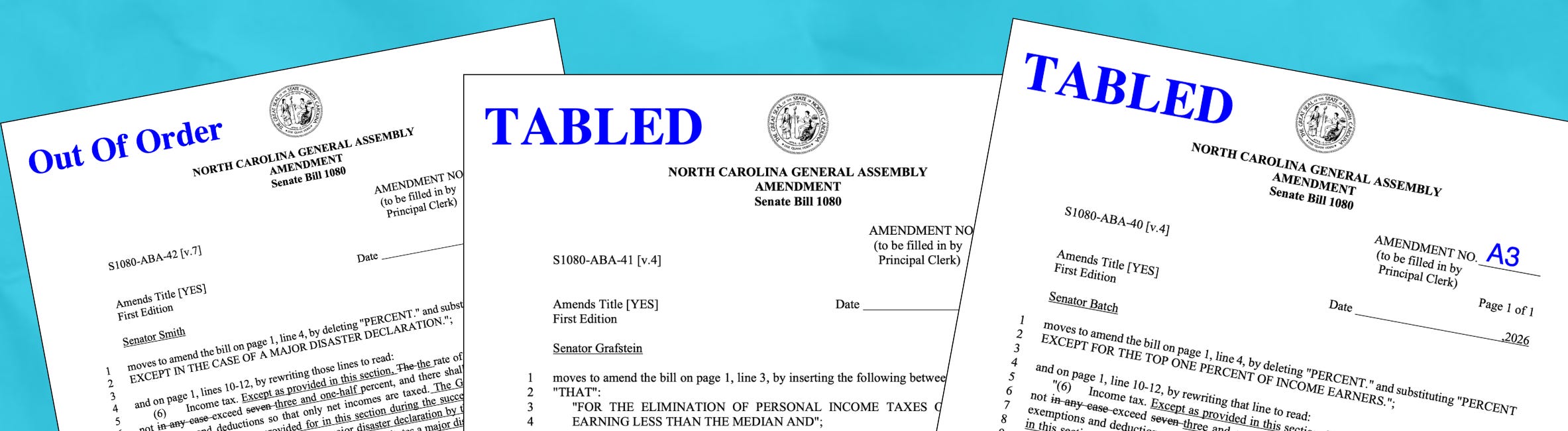
Senate Democrats know how dangerous this is, but we also recognize that the average North Carolinian is hurting in this terrible economy built by Republicans. That’s why we offered three amendments to help fix this constitutional amendment, while still delivering relief to the people who need it:
First, Sen. Smith offered an amendment that would have created a disaster exception, suspending the cap for two fiscal years after a federally declared major disaster. Republicans were so afraid of being caught on the record voting against hurricane victims that they invented a brand-new procedural argument to rule it out of order, and the Lieutenant Governor agreed with them on the spot — no debate, no vote, no opportunity for our members to even make the case.
Then, Sen. Grafstein introduced an amendment that would have eliminated the state income tax entirely for every North Carolinian making below the median income — that’s roughly half the state — while keeping the existing 7% cap for higher earners. Republicans rejected it.
Finally, Leader Batch’s amendment would have applied the 3.5% cap to 99% of filers, but excluded the top 1% — so the wealthiest North Carolinians couldn’t lock in a permanent break at everyone else’s expense for the rest of time. Republicans rejected that one too.
Three serious amendments with three real solutions to actually lower your bills. That’s what we proposed. But, unfortunately, the Republican Supermajority said “NO” to all of them.
S1082: Enshrining Anti-Union Rules That Are Already on the Books
The work of passing constitutional amendments then continued on Wednesday, first with Senate Bill 1082 — a constitutional amendment to put “right to work” into the state constitution.
Here’s the thing: “right to work” has been North Carolina law for nearly 80 years. Republicans don’t need a constitutional amendment to keep it on the books. They already have it. What they want is to make it permanent and untouchable, so no future legislature can ever expand the rights of North Carolina workers.
And Republicans haven’t exactly been subtle about that point. In committee, Sen. Alexander defended the amendment by saying: “People are moving here from all over. And what we want to make sure is… that that policy would continue to stand and has served us so well over the past number of years and that this would continue on without the whim of political change.”
Strip away the careful phrasing and here’s what he’s actually saying: as new people move to North Carolina with different values, Republicans want to make sure today’s rules can never be changed by tomorrow’s voters. That’s not protecting the people of North Carolina. That’s protecting Republican policy from the people of North Carolina.
Even Senate leader Phil Berger basically admitted what this is really about. When asked whether the amendment was an attempt to drive Republican turnout in November, he said he didn’t know (yeah, sure) — but “if it’s something that’s popular with the people and it brings more people out to vote, I think everybody ought to be in favor.”
Translation: this isn’t about policy. It’s about politics.
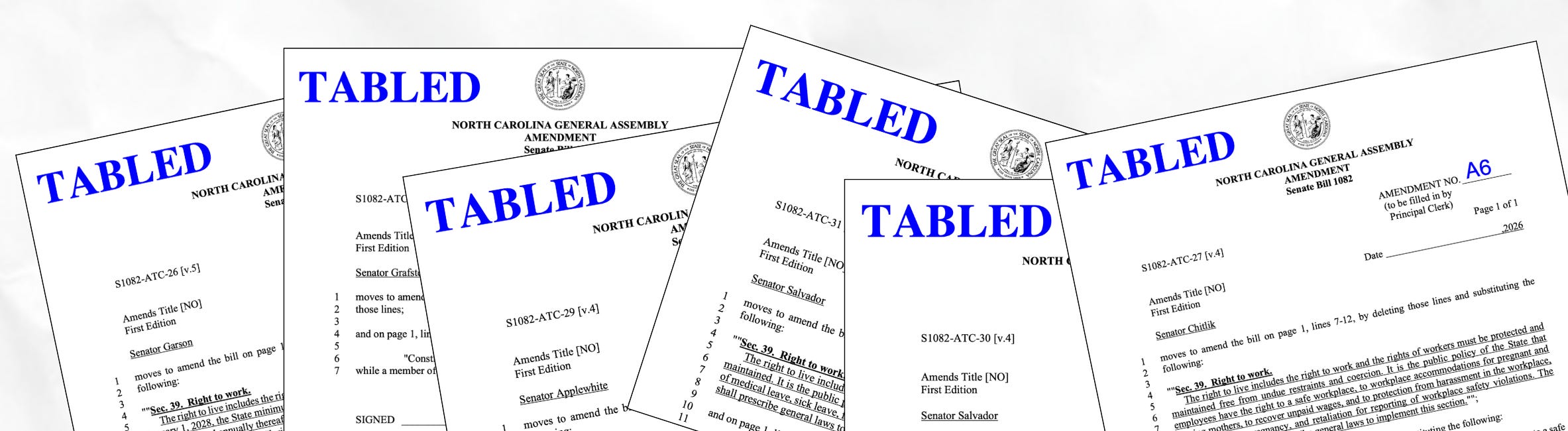
So, Senate Democrats came with six amendments to try and make S1082 actually mean something for the people doing the work in this state:
Sen. Garson’s amendment would have guaranteed that the right to work includes the right to a living wage that keeps up with the cost of living.
Sen. Grafstein’s amendment would have banned discrimination — including firing — against workers for joining a labor organization.
Sen. Applewhite’s amendment would have guaranteed all public employees — including law enforcement officers and first responders — the right to collectively bargain.
Sen. Salvador’s first amendment would have established paid medical leave, sick leave, family leave, and breaks as a guaranteed right for every worker in North Carolina.
Sen. Salvador’s second amendment would have given local governments the authority to set a minimum wage higher than the federal or state floor, and to require employers to provide paid family leave and sick days.
Sen. Chitlik’s amendment would have added the right to a safe workplace, the right to recover unpaid wages, protection from retaliation for reporting safety violations or harassment, and protections for workers who are pregnant, including reasonable accommodations and protection from being fired.
Every single one of these solid, worker-first ideas was rejected without real debate. Senate Republicans wouldn’t even consider whether you deserve a living wage, a safe job, or protection from being fired for being pregnant.
Think about that for a second. They want to put “right to work” in the constitution, but they wouldn’t put the right to a paycheck that keeps up with rent. They wouldn’t put the right to come home from work safe. They wouldn’t put the right not to be fired while pregnant. They wouldn’t even let local communities decide for themselves what a fair wage looks like in their own backyard.
That’s not granting you the “right to work.” It’s granting you the “right to be screwed over by your employer forever.”
H1089: Tying the Hands of Local Government, Too
They say bad things come in threes. Such was the case with constitutional amendments in the Senate Chamber, when Republicans concluded the week by passing House Bill 1089 — a constitutional amendment that would force the General Assembly to cap local property tax increases.
Here’s the part that should make every North Carolinian pay attention: the bill doesn’t even tell you what the cap is. Republicans say the cap gets decided next year, but the truth is even murkier than that — when our members pressed for a specific timeline on the floor, there was no firm answer and there’s no deadline written into the bill. Republicans want voters to approve a constitutional amendment in November without telling them what they’re actually voting for, and without committing to when they’ll fill in the blank.
Not to mention, the General Assembly already has the authority to impose levy limits without amending the constitution, which means we certainly don’t need this amendment to do what they say they want to do on property taxes. So why force it into the constitution?
Because once it’s in the constitution, every county commission and every city council in North Carolina is permanently boxed in. Local services — schools, fire, EMS, water, sewer, libraries, parks — depend on local revenue. When Raleigh ties their hands, the bills don’t disappear. They just get harder to pay.
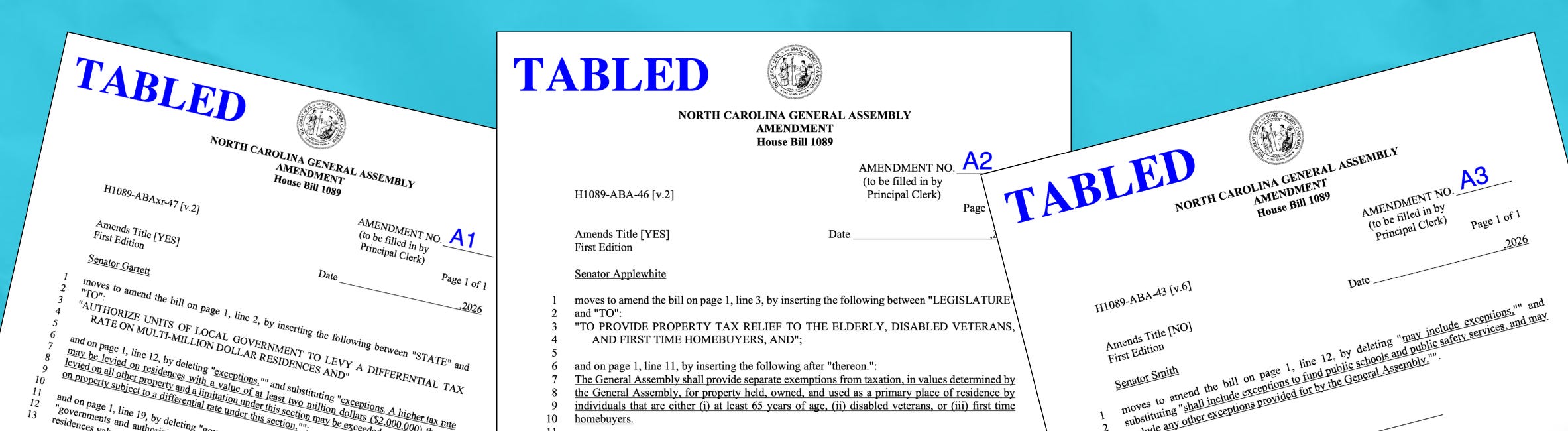
That’s why Senate Democrats brought three amendments to H1089:
Sen. Garrett’s amendment would have ensured that owners of residential properties valued at $2 million or more could not benefit from the property tax cap. If this is really about protecting working families from sharp tax hikes, why should mansion owners get the windfall?
Sen. Applewhite’s amendment would have required relief for the elderly, disabled veterans, and first-time homebuyers — the people who actually feel property tax increases the hardest.
Sen. Smith’s amendment would have exempted local levies needed to maintain current funding for public schools and public safety, and required the state to replace any local revenue shortfalls caused by the cap.
All three were rejected. Yet again, Republicans couldn’t bring themselves to vote in support of disabled veterans, seniors, and first-time homebuyers who deserve targeted relief.
326 Days and You Can Keep Counting
While Republicans were super busy working to lock their political priorities into the constitution, North Carolina remained the only state in the nation without a budget.
We are now 326 days into the fiscal year, and it has been 973 days since the last time Republicans in the legislature passed a state budget back in 2023.
And after all of this — after pushing five constitutional amendments through committee, after blocking a dozen Democratic amendments, after still not putting out an actual budget — the legislature’s response is to go home for the week.
That’s right. Next week is Memorial Day, and Republicans are taking the whole week off. Meanwhile, the teachers, state employees, troopers, and working families they claim to represent are getting up every morning, going to work, and figuring out how to make rent, pay the light bill, and keep food on the table — all without the budget Republicans were supposed to pass nearly a year ago. When everyone else in North Carolina is working harder than ever just to keep up, the Republican supermajority decides this is the moment to clock out.
When they come back, maybe — maybe — they’ll start working in earnest on a budget. Who knows, maybe we’ll see something in June? Maybe July? Maybe never?
Either way, the clock keeps ticking, things keep getting worse, and Republicans keep doing nothing.
This is exactly why we told you not to buy the framework hype two weeks ago. A press release isn’t a budget. A press conference isn’t a budget. A “framework” isn’t a budget. It means nothing until we see real numbers on a spreadsheet and real line items funding the priorities of real North Carolinians.
Until then? We’ll keep counting every day of the Republican supermajoritie’s unbelievable failure.
What to Watch Next Week
The constitutional amendments still have more steps to go before they all hit the ballot. Here’s what to keep an eye on:
The House and the right to work amendment. S1082 passed the Senate this week, but it has not yet been taken up by the House. Until the House passes it with a three-fifths supermajority, it does not go on the ballot. Watch how quickly the House moves, whether they hold real debate, and whether any House members are willing to break from leadership on locking an 80-year-old anti-union policy permanently into the constitution.
The referendum schedule and bundling on the tax amendments. The property tax cap (H1089) and the income tax cap (S1080) have both cleared both chambers and will be on the November ballot. Republicans are openly saying the quiet part out loud about driving turnout this fall. Watch what else they try to pile onto the ballot, and how the amendments get worded. The fewer details voters see, the better Republicans like their odds.
The actual budget bill. Republicans still haven’t released the rest of their two-week-old “framework” as an actual budget. We’ve heard “next week” before. Watch for the bill text, because frameworks and press conferences are easy. Bill text is where the truth lives. Read the fine print on the raises, the bonuses, the retroactivity, and what’s getting funded versus what’s getting cut.
Who shows up for working families. The twelve amendments Senate Democrats filed this week aren’t going away. There will be more chances — in the House, in conference, and in the budget itself — for Republican lawmakers to actually deliver living wages, disaster protections, real tax relief, and basic fairness. We’ll continue to take every chance we get to fight for working North Carolinians and will keep trying to put their needs first.
Even when Republicans aren’t willing to work with us for your betterment, we’re still here for you.
Ways to Contact the Office of Leader Batch
📍 Office: NC General Assembly, 16 W. Jones St., Rm. 1026, Raleigh, NC 27601
📞 Phone: 919-733-5653
📧 Email: Sydney.Batch@ncleg.gov
Connect on Social Media
For real-time updates, follow Leader Batch on social media!